
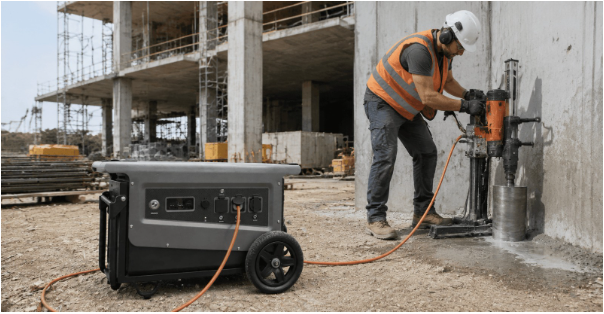

Everyone who has ever been in charge of an earthmoving operation, a big mining activity, or a huge crop growing project will confirm one thing: that no working man gets his work halted because the weather turns sour. Storm, slush, dust, and icy winds are all just part of the working conditions of a site, and the devices that keep the site going are required to endure them all and still remain efficient. That is why increasingly crews as well as site managers are turning their backs to the noisy ones diesel generators which were the only power sources available for them and instead they are getting themselves a tough Industrial Power Station that has the robust build and the ability of standing even the toughest situation of a job without being defeated in any way by it. With the latest trend the generators have become even the principal source of providing electricity for power tools, lighting units, welding equipment and even small machinery at isolated worksites which rely on no external grid.
Why Outdoor Projects Need a Different Kind of Power Source
Normally, a regular power station, the type for camping or home backup, is not built for survival but rather for convenience. These power stations can work for powering up a phone at a tailgate event, but they were never made to last when sitting in a puddle of mud, while nearby a crew is hammering a foundation, or keep running after a heavy downpour has suddenly soaked the whole site for minutes in a row.
Because of unpredictable outdoor industrial work, the equipment used in it has to be over-engineered for conditions that would destroy consumer-grade electronics in a morning.
A good example of a Waterproof Power Station is a sealed one. Not only are these units resistant to a light drizzle, but they are also built with sealed enclosures, protected ports, and internal components that keep moisture, dust, and grime from reaching the battery cells or the circuitry at all. At a job site, that difference is not just a luxury feature; it is a deciding factor: whether your unit keeps running without stopping during a storm or if it shorts out during the middle of the working shift, which would mean your crew is out of service for hours and will also face a very expensive repair bill.
The Real Demands of Heavy Equipment
It’s one thing to power your phone with a phone charger but entirely another to power an angle grinder, a concrete mixer, floodlights for a night shift, or a compressor with a portable power station. Large machines require high amps of electricity, which may be delivered in very short, sharp bursts that put significant stress on the power system.
A portable generator that is going to be brought to the construction site and used on a daily basis needs some features that the consumer model generally would miss out:
- High continuous and surge wattage, the generator has enough capacity to supply your tool startup spike without tripping or shutting down.
- Multiple output types, AC mains for your cords-only tools, DC outlets for those little ones like phones and PDAs, 3-phase and other high voltages are also available for the special machines.
- Fast recharge power stations can get charged through solar panels, backup generators, or while the crew are moving from one job to another so there’s no need to wait idle for a wall socket that might not exist on your worksite at all.
- A robust casing, a housing that can take quite a beating and still keep it in one piece.
Putting all those together the result is a piece of equipment you can use in extreme weather conditions without fearing that your generator will be out of order for you.
Weatherproofing Isn’t Just About Rain
It is a common misconception that the term waterproof refers only to rain, but in the context of a worksite, there are many other sources of moisture that would be damaging to unprotected equipment.
Morning dew settles on tools that have been left outside the night before, pressure washers blast water to clean the work space, and in coastal, tropical, or particularly humid regions, water vapor can invade even the most cautious of workspaces and eat away at unprotected metal. Meanwhile, moisture that has entered an unprotected toolbox from some unknown source could ruin electrical equipment that was mistakenly stored there.
The purpose of an IP (Ingress Protection) rating on outdoor power tools is to specify its resistance to water or foreign objects, so if the tool is rated at least an IP65, it has been tested to be completely dust-proof and able to withstand low-pressure jets of water from any direction, which should be sufficient for most tasks. It is best to do your own research when buying outdoor power tools, as a cursory examination of the product description may lead you to believe that a tool is weather resistant if it is simply waterproof, but the two terms are not necessarily synonymous.
Battery Chemistry Matters Just as Much as the Shell
A weatherproof casing is only a part of a battery’s functionality, and what matters most is what’s on the inside. Especially considering that some days may be quite chilly in the morning and sweltering hot in the afternoon. Modern equipment that is designed to be used outdoors is very common with LiFePO4 batteries for a reason. They can withstand higher temperatures than lithium-ion counterparts without degrading as quickly, offer vastly increased charge cycle endurance, and are significantly more resistant to thermal runaway events in the case of a malfunction. Considering that a battery pack for equipment that is exposed to direct sunlight for a period of ten hours daily, such qualities are all but necessary.
Combined with a waterproof external casing, such characteristics would endow the battery with both convenience and unrivaled reliability in the face of adverse weather conditions, a feat that very few would be able to accomplish in less than a week.
Practical Scenarios Where This Makes a Difference
Suppose a construction crew is working on a road in the rain, and one of the workers has an idea to turn off the generator so that it won`t be damaged by the torrential downpour. But what if there was a generator that was well protected, and could keep the floodlights on and the battery of tools charged during the deluge?
Imagine being on an installation crew for a solar power plant that is being constructed in a remote area, and there is no access to the grid. The only way to provide power is a portable solar battery that provides you with the ability to work for weeks at a time. On the farm, water pumps, stock equipment, wire fence tools, and more, need to be powered in places where there is no easy access to water or the grid. The equipment is subject to dirt, rain, and extreme temperatures during the planting and harvesting season. The outdoor film and television crews are plagued by the same issues, because they need to provide their own power for cameras and lights, but gas-powered generators give off odors and are noisy.
What do these examples have in common? The need for a power supply that is able to withstand the same conditions as the worksite it is being used on.
What to Look for Before Buying
If your group is thinking about making the leap to a heavy-duty battery power system, then it would be wise to pose the following queries before deciding on a particular piece:
- What is the protection against dust and water(IP) rating of the battery?
- What are the sustained power output and temporary power capacity for big tools?
- The way the batteries are getting charged and how fast it happens, particularly when the sun is used to power it.
- What type of batteries are they using, and what is the expected longevity?
- Has the housing been verified in harsh climates for extreme temperatures or weather?
Being prepared to answer the aforementioned questions will save a lot of headaches in the future, especially if the unit is placed somewhere that is hard to get back or make repairs.
Final Thoughts
You may come to terms with the fact that the outdoors are not suitable for many of your needs, but the same cannot be said about your equipment. Heavy-duty, low-noise generators can eliminate the need for gas- and noise-producing machines. Reinforced battery banks are proving that the combination of ultra-tough, reinforced construction and the ability to resist the elements can be combined with a degree of convenience previously unseen in the industry. It doesn’t matter if it’s for worksites, farms, or remote installations; it seems that the need for such a device in every situation is becoming more and more apparent.